
Archive edition: Week 22, 2025. The commentary and figures reflect the original publication period, not current market conditions. These are Ed le Feuvre's personal observations, not investment advice. Read the full disclaimer.
Dear Quay Financials,
Pour yourself my favourite drink… a double espresso… and settle in, because Week 22 delivered yet another twist in the 2025 market drama. After last week’s “FOMO to Pause” reality check, this week saw investors wrestling with mixed signals: equities bounced, gold staged a comeback, and central bankers continued their high-wire act with all the poise of a juggler at a circus.
As usual, I’ll reflect on what changed, what didn’t, and what it all means for your portfolio, with a few final thoughts on the Goldilocks dilemma facing investors everywhere.
Alongside this week’s market review, I thought I’d serve up some brunch-time reading on the macro realities of private equity exits, no homework required, just a little perspective to chew on while you balance that messy egg on your fork and sip your second coffee.
So, what happened this week as the dust settled? Let’s dig in.
Recap: Where We Left Off (Week 21)
Last week, we saw the exuberance of Week 20 give way to a more measured tone:
- Profit-taking and rebalancing after a FOMO-fueled surge.
- US credit downgrade and sticky UK inflation reminded us that fiscal and monetary realities matter.
- Gold stabilized after its wild swing, and Bitcoin kept flirting with record highs.
- The mood? “Pause and reassess” with the CNN Fear & Greed Index sliding from “Greed” to “Neutral.”
This Week: Markets Bounce, Macro Clouds Linger
US & Global Equities:
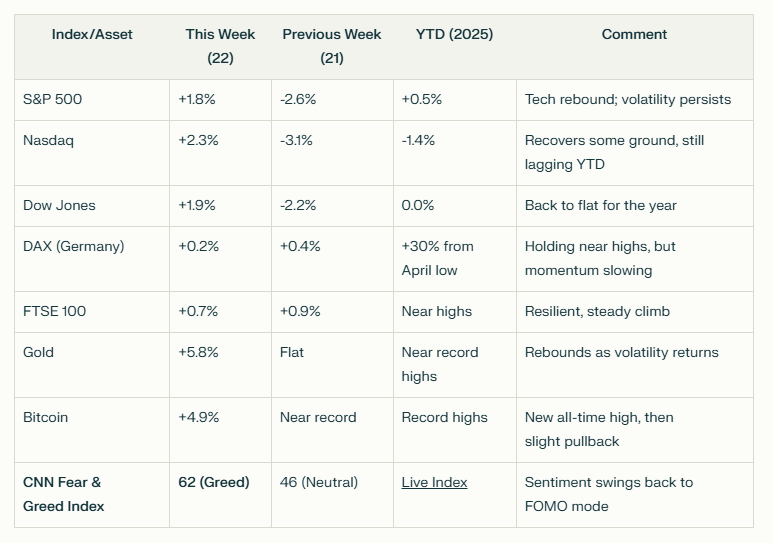
- S&P 500 and Nasdaq rebounded after last week’s pullback, with tech regaining some lost ground. The Dow joined the party, up over 1.8% 1.
- FTSE 100 continued to grind higher, supported by a resilient UK economy and a still-dovish Bank of England.
- DAX (Germany) and European equities were mixed, with the DAX holding near record highs but showing signs of fatigue.
- Gold snapped back nearly 6% to $3,360/oz, reclaiming all of last week’s losses as investors hedged against renewed volatility.
- Bitcoin notched another record, briefly topping $112,000 before settling just below.
Macro & Policy:
- US Treasury yields remained elevated, with the 30-year above 5% (a level not seen since 2023) as deficit worries and the credit downgrade lingered1.
- Fed minutes (May 7) confirmed the “higher for longer” stance, with policymakers focused on sticky inflation and a cautious approach to rate cuts5.
- China’s PMI remained in contraction (49.5), as trade tensions with both the US and EU weighed on manufacturing and sentiment3. However, Q1 GDP growth was a robust 5.4% YoY, and hopes for a US-China tariff thaw are building.
- Europe & UK: UK inflation remains stubborn, but the FTSE is buoyed by a global risk-on mood. The euro area is showing slow but positive momentum.
Sentiment:
- The CNN Fear & Greed Index has bounced back to 62 in “Greed” territory, reflecting renewed optimism and a familiar whiff of FOMO. You can check the latest reading here.
Weekly Market Table
What’s Pertinent This Week?
- Central Bank Tightrope: The Fed’s “higher for longer” message is being echoed by other central banks, but markets are still hoping for a Goldilocks outcome; not too hot, not too cold. The risk? Policy error if inflation proves stickier than hoped, or if growth slows too quickly.
- China’s Crosswinds: Despite strong Q1 GDP, China’s manufacturing PMI remains in contraction as trade tensions with the US and EU drag on. The world’s second-largest economy is still searching for footing, and any breakthrough in tariffs could change the global mood.
- US Fiscal Worries: The credit downgrade and rising Treasury yields are a reminder that deficits and debt service costs are back in the spotlight. The 30-year yield above 5% is a wake-up call for risk assets and government budgets alike.
- Gold’s Comeback: After last week’s breather, gold’s sharp rebound is a timely reminder that the old yellow metal still has a role to play as a hedge when volatility and uncertainty return.
Ed’s Portfolio Corner: The Goldilocks Dilemma
As we continue our journey in private equity and portfolio management education, it’s worth pausing to ask: are we in a “just right” market, or is the porridge about to spill? The reality is, markets are caught between the hope for soft landings and the risk of policy missteps. That’s why I keep harping on diversification and resilience….because in a world of shifting narratives, you need assets that can zig when others zag.
Gold’s rebound this week is a perfect case in point. After being left for dead during the FOMO rally, it’s back in demand as investors hedge against both inflation and policy error. Bitcoin’s record run, meanwhile, shows that the appetite for “alternative hedges” is alive and well. And as China’s data shows, global growth is anything but a straight line.
So, as you contemplate your next allocation over that Sunday breakfast, remember: the markets are rarely “just right” for long. Stay nimble, stay curious, and don’t be afraid to keep a little gold (or even some digital gold) in your mix.
Navigating the Exit Maze: Macro Insights for Private Equity Investors
As private equity portfolios mature, exit planning comes into focus. I thought it timely to offer a macro-economic perspective on the realities and opportunities facing private equity sellers today.
Think of it as some extra food for thought to chew over with your Sunday brunch.
The State of Play:
According to McKinsey’s 2025 Global Private Markets Report, private equity is emerging from a tricky patch. After two years of murky conditions, 2024 finally saw an uptick in distributions to investors, the first time since 2015 that more cash was returned than called. This is big news for LPs, many of whom have been waiting (not always patiently) for realizations to catch up with the “paper” value of their portfolios.
But let’s not sugarcoat it: the exit environment is still challenging. Fundraising for traditional PE vehicles fell for a third straight year, dealmaking remains below pre-pandemic highs, and the backlog of unsold sponsor-owned companies is now the largest in two decades. Many GPs are facing the twin pressures of elevated portfolio marks (thanks to the exuberant valuations of 2021–22) and a tougher market for outright sales, especially as buyers are more discerning and financing, while improving, is still pricier than the cheap-money era.
What’s Driving the Exit Backlog?
- Higher-for-Longer Rates: The rapid rise in global interest rates since 2022 has made leveraged buyouts more expensive and complicated the math for potential acquirers.
- Valuation Gaps: Sellers are anchored to peak valuations, while buyers expect discounts for risk and higher funding costs. That’s led to more deals falling through or being restructured as continuation vehicles or secondary sales.
- Geopolitical and Macro Uncertainty: From tariffs to elections to AI disruption, the macro backdrop is anything but clear. This makes buyers more cautious and sellers more creative.
- Innovation in Exit Routes: The market is seeing more sponsor-to-sponsor deals, more use of continuation funds, and a rise in public-to-private transactions; especially in Europe, where P2P activity jumped 65% last year.
The Good News: Resilience and Adaptation
Despite these headwinds, the industry is adapting. GPs are getting creative with structures, LPs are increasingly open to secondary solutions, and the long-term performance of private equity still outpaces public markets. In fact, 30% of LPs surveyed by McKinsey plan to increase their PE allocations over the next year; a vote of confidence in the asset class’s ability to deliver, even in choppy waters.
What Should Private Equity Investors Watch For?
- Timing and Flexibility: Exits may take longer and require more creativity…. think staged sales, minority stakes, or continuation vehicles.
- Valuation Discipline: Be realistic about marks and open to price discovery. The market is rewarding quality and operational improvement over financial engineering.
- Macro Awareness: Stay alert to interest rate trends, geopolitical shifts, and sector-specific risks (and opportunities) as you plan and execute exits.
For a deeper look at the data and trends shaping the exit landscape, I recommend reading the McKinsey Global Private Markets Report 2025.
Ed’s Final Word
Week 22 reminded us that markets are never static. After a pause, the bounce returned; but so did the questions about growth, policy, and what comes next. Central banks are still holding the reins, but the road ahead is anything but straight. For private equity and risk asset investors, the lesson is clear: keep your eyes on the horizon, your portfolio balanced, and your breakfast hearty.
As always, these are the thoughts and opinions of mine and no one else’s; not even Quay Financials (Gibraltar) Limited. Please do your own research before making investment decisions and reach out to Quay Financials if you have any queries or follow-ups.
Further Reading:
- Manulife John Hancock – Weekly Market Recap
- Reuters – China’s May manufacturing activity likely contracted for second straight month
- KPMG – China Economic Monitor Q2 2025
- Comerica – May 2025 U.S. Economic Outlook
- Federal Reserve – FOMC Minutes, May 2025
- McKinsey Global Private Markets Report 2025
Week 22, 2025: In markets, the only constant is change; so keep your wits, your watchlist, and your breakfast close at hand.
Full Disclaimer
The views expressed in this blog are my own personal market observations and reflections. They do not constitute investment advice, a financial promotion, or a recommendation to buy or sell any security. This publication is not made in my capacity as a director of Quay Financials (Gibraltar) Limited, which is authorised and regulated by the Gibraltar Financial Services Commission. You should always conduct your own research and seek independent advice appropriate to your circumstances before making any investment decision.
Information has been obtained from sources believed to be reliable, but no representation or warranty is given as to its accuracy, completeness or timeliness. Market levels, weekly changes and year-to-date figures in the table are reproduced from the original Week 22 source material and have not been independently re-calculated for this web conversion. The value of investments and the income derived from them may fall as well as rise, and investors may not recover the amount originally invested. Past performance is not a reliable indicator of future results. Readers should conduct their own research and obtain independent professional advice appropriate to their circumstances before making an investment decision.
