
Archive edition: Week 23, 2025. The commentary and figures reflect the original publication period, not current market conditions. These are Ed le Feuvre's personal observations, not investment advice. Read the full disclaimer.
Dear Quay Financials,
Pour yourself my favourite drink, a double espresso, and settle in for another week of market drama. For those nonagenarians among us who know how to take brunch in style, consider pairing your espresso with a grappa and a splash of water, no ice. (Yes, it’s a thing, and yes, it’s a heck of a lot better than it sounds.)
Week 23 was as eventful as a Sunday brunch with too many guests: markets swung on geopolitical feuds, tech titans traded barbs, and central bankers kept everyone guessing. As always, I’ll reflect on what changed, what didn’t, and what it all means for your portfolio; with a few extra thoughts on how to navigate the chaos with a dash of humour and a splash of perspective.
Recap: Where We Left Off (Week 22)
Last week, we saw markets bounce back from a brief pause, with tech and gold both staging comebacks. The mood swung back into “Greed” territory, and central banks stayed the course on rates. Meanwhile, last week’s commentary set the stage for a deeper look at exit strategies.
Markets are like brunch: just when you think you’ve seen it all, someone orders a mimosa with a side of avocado toast. Last week’s rebound was a reminder that sentiment can turn on a dime, just like the mood at a crowded brunch table when the last plate of pancakes arrives.
This Week: Feuds, Fizz, and a Touch of Chaos
US & Global Equities:
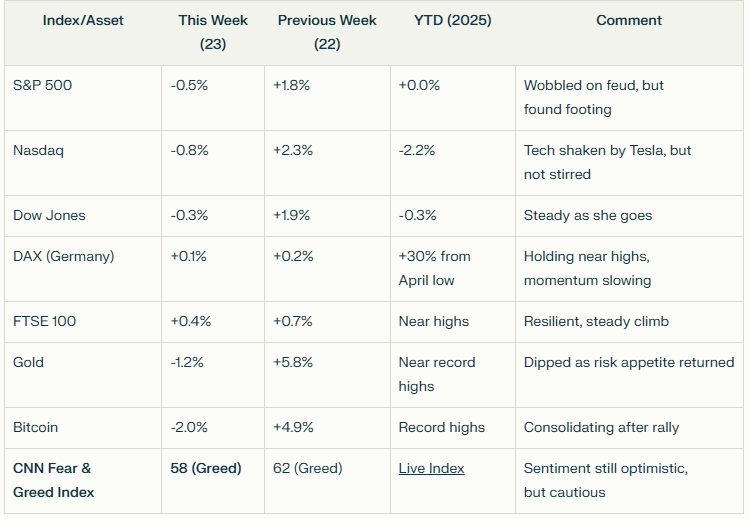
- S&P 500 and Nasdaq wobbled midweek on the Trump-Musk feud but found their footing by Friday, with tech stocks showing surprising resilience.
- FTSE 100 edged higher, buoyed by a weaker pound and hopes for further BoE easing.
- DAX (Germany) held steady near record highs, while European markets kept a watchful eye on US-China trade talks.
- Gold dipped slightly as risk appetite returned but remained elevated as a hedge against ongoing volatility.
- Bitcoin consolidated near record highs, proving once again that digital gold can be as unpredictable as a brunch guest who insists on ordering dessert first.
Macro & Policy:
- US Treasury yields remained elevated, with the 30-year above 5% as deficit worries persisted.
- Fed officials reiterated a cautious “higher for longer” stance, while the Bank of England hinted at further rate cuts if inflation cools.
- China’s manufacturing PMI remained in contraction, but hopes for a tariff thaw kept sentiment from souring further.
- Europe & UK: UK inflation remains stubborn, but the FTSE is supported by a risk-on mood. The euro area is showing slow but positive momentum.
Economic Analysis: The Trump-Musk Feud
The week’s most dramatic storyline was the public falling-out between Donald Trump and Elon Musk. What began as a policy disagreement over a major tax bill quickly escalated into a full-blown feud, with Trump threatening to cut government contracts and subsidies for Musk’s companies, and Musk responding with calls for impeachment and a dramatic halt to SpaceX’s Dragon spacecraft operations (later retracted).
Market Impact:
Tesla’s stock plunged over 14% in a single day, its largest drop ever, erasing around $150 billion in market value and dragging down the broader tech sector. The fallout rippled through the markets, with the S&P 500, Dow, and Nasdaq all taking a hit before recovering later in the week. The feud also cast a shadow over the future of US space ambitions and the electric vehicle (EV) sector, as Trump’s proposed bill threatens to eliminate EV tax credits and subsidies worth billions.
Broader Implications:
The Trump-Musk spat is a reminder of how personal feuds and political drama can spill into the markets, creating volatility and uncertainty for investors. For Tesla, the stakes are high: the loss of government support and tax incentives could shave billions off its bottom line and slow the adoption of electric vehicles in the US. For the broader market, it’s a cautionary tale about the risks of mixing business, politics, and social media 236.
Ed’s thoughts:
If you ever doubted that personalities move markets, this week should put that to rest. The Trump-Musk feud was like watching two titans argue over the last croissant at brunch; except the croissant in question was worth billions. The lesson? In today’s world, even the most mundane policy debate can turn into a market-moving spectacle.
Weekly Market Table
What’s Pertinent This Week?
- Trump-Musk Feud: The public spat between Trump and Musk dominated headlines and drove volatility, especially in the tech sector. Tesla’s dramatic drop and subsequent recovery underscored the fragility of market sentiment in the face of political drama.
- Policy Uncertainty: The feud has raised questions about the future of government support for EV and space exploration, with potential knock-on effects for the broader tech and green energy sectors.
- Central Bank Watch: The Fed and BoE remain cautious, with rates likely to stay high for longer. Investors are parsing every word for clues on future policy moves.
- Global Growth: China’s manufacturing PMI remains weak, but hopes for a tariff thaw are keeping sentiment from souring further. Europe and the UK are showing slow but positive momentum.
Ed’s thoughts:
This week was a reminder that markets are as much about psychology as they are about fundamentals. The Trump-Musk feud was like a brunch table argument that spilled over into the kitchen…. and everyone’s watching ….. and no one’s quite sure how it will end. The key takeaway? Keep your portfolio balanced and your sense of humour intact.
Private Equity’s Macro Insights
The Exit Wave: A Glimmer of Light on the Horizon
As private equity portfolios mature, exits are top of mind, and for good reason. As we saw last week, the McKinsey’s 2025 Global Private Markets Report, the backlog of unsold sponsor-owned companies remains at a record high. Yet, unseen and in the background, the macro environment is quietly shifting in favour of exits.
Interest rates are beginning to drop. The U.S. Federal Reserve, having held rates steady at 4.25–4.50%, now foresees two cuts by year-end, potentially bringing the target range down to 3.75–4.00%. The European Central Bank, too, has started cutting rates, citing inflation under control and a cautiously optimistic outlook for growth. This marks a clear pivot from restrictive to neutral or even accommodative policy, as central banks seek to avoid a sudden cooling of the labour market and keep the economy on track.
Monetary policy and liquidity conditions have already moved favourably. The U.S. M2 money supply has climbed to a record $22 trillion in April 2025, signalling the end of tightening and a return to monetary expansion. While this liquidity surge hasn’t yet fully trickled through to the real economy or deal pipelines, it’s a powerful tailwind for market sentiment and, eventually, for exit activity.
Market volatility and high-profile shocks like Trump-Musk feud and tariffs uncertainty can create short-term profitable disruptions. As research shows, private equity firms have historically leveraged “windows of opportunity” in shifting monetary environments to execute exits via IPOs, mergers, or secondary sales. The current environment of uncertainty means there are good deals to be had; that with rates poised to fall, liquidity abundant, and central banks dialling back tightening; suggests that private equity my see significant activity in the very not to distant future.
Ed’s thoughts: With interest rates dropping, liquidity on the rise, and central banks in easing mode, we may be on the cusp of a favourable exit environment; even if the full effect hasn’t yet reached “Main Street”. For the nimble and prepared, this could be the moment ready to move when the market’s appetite returns.
Gold: The Timeless Hedge in a Modern Portfolio
Gold dipped slightly this week as risk appetite returned, but it remains a key hedge against volatility and uncertainty. For those who like to keep their portfolio balanced, a modest allocation to gold (or even digital gold) is still a wise move; especially in a world where feuds and policy surprises can move markets overnight.
Gold is like the grappa at brunch: not everyone’s cup of tea, but it’s there when you need a little extra fortification. In today’s market, a touch of gold can help smooth out the bumps and keep your portfolio on track.
Ed’s Final Word
Week 23 was a reminder that markets are never dull, especially when personalities collide and policy debates turn into public feuds. For private equity and risk asset investors, the lesson is clear: stay nimble, stay diversified, and don’t be afraid to add a splash of grappa (or gold) to your portfolio.
As always, these are the thoughts and opinions of mine and no one else’s; not even Quay Financials (Gibraltar) Limited. Please do your own research before making investment decisions and reach out to Quay Financials if you have any queries or follow-ups.
Further Reading:
- CNN Fear & Greed Index (Live)
- McKinsey – Global Private Markets Report 2025
- Reuters – Trump-Musk Feud
- NY Times – Trump-Musk Spat
- CNBC – Tesla’s Big Problems
- DW – Trump-Musk Feud
Week 23, 2025: In markets, the only constant is change; so keep your wits, your watchlist, and your breakfast close at hand. And if you’re feeling adventurous, try that double espresso with a splash of grappa. You might just like it.
Full Disclaimer
The views expressed in this blog are my own personal market observations and reflections. They do not constitute investment advice, a financial promotion, or a recommendation to buy or sell any security. This publication is not made in my capacity as a director of Quay Financials (Gibraltar) Limited, which is authorised and regulated by the Gibraltar Financial Services Commission. You should always conduct your own research and seek independent advice appropriate to your circumstances before making any investment decision.
Information has been obtained from sources believed to be reliable, but no representation or warranty is given as to its accuracy, completeness or timeliness. Market levels, weekly changes and year-to-date figures in the table are reproduced from the original Week 23 source material and have not been independently re-calculated for this web conversion. The value of investments and the income derived from them may fall as well as rise, and investors may not recover the amount originally invested. Past performance is not a reliable indicator of future results. Readers should conduct their own research and obtain independent professional advice appropriate to their circumstances before making an investment decision.
