The views expressed in this blog are my own personal market observations and reflections. They do not constitute investment advice, a financial promotion, or a recommendation to buy or sell any security. This publication is not made in my capacity as a director of Quay Financials (Gibraltar) Limited, which is authorised and regulated by the Gibraltar Financial Services Commission. You should always conduct your own research and seek independent advice appropriate to your circumstances before making any investment decision.
Dear Quay Financials,
Sunday evening on the Rock, and the Strait below is back to its usual choreography. Ferries cut their patient diagonals across the bay, a couple of container ships slide past Europa Point, and the late light off Algeciras does its best to pretend nothing truly bad ever happens on water. From a café table in Casemates, you could almost believe the world has remembered how to exhale again. Almost.
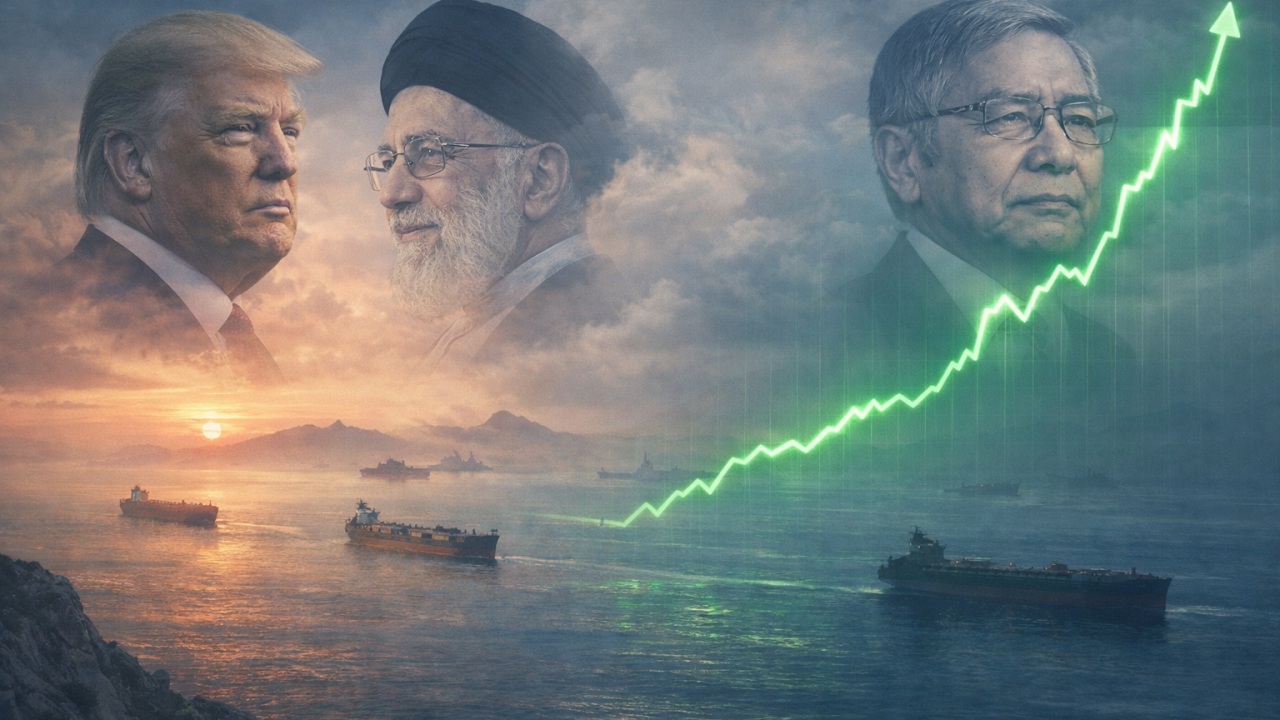
A few thousand miles to the east, the water still tells a different story, but for the first time in weeks, it is at least a less frightening one. A twoweek ceasefire between the US and Iran has turned the volume down in Hormuz, tankers are beginning to move with something approaching regularity, and WTI has stepped back from 110 and settled uneasily in the high90s. At the same time, Japan’s bond market continues to insist that the era of “free yen duration” is not merely over but being replaced by something structurally more expensive, even as the Nikkei keeps rewriting the record book. Meanwhile, US and global risk assets have looked straight through 4handle Treasury yields and decided that, for now, they can live with the price of time.
So, espresso in hand and the Levanter finally taking a day off, let’s walk through a week where three narratives did the heavy lifting: a war premium that blinked but did not disappear, a Japanese market that refuses to choose between equity exuberance and bond austerity, and a global risk complex that rallied not despite higher yields, but alongside them.
Recap: Where Week 14 Left Us
Week 14 closed with markets priced for a world where chokepoints, not central banks, were setting the marginal price of risk. Hormuz and the wider Gulf had shifted from headline risk to working energy tax: frontmonth WTI settled near 111.54 dollars per barrel, Brent spent the week north of 110, and every refinery planner on the planet was suddenly in the geopolitics business. US labour data delivered “stabilisation without salvation”, 178,000 March payrolls and 4.3% unemployment, just enough to stop the recession drumbeat, nowhere near enough to convince the Fed it could cut into a wardriven oil spike.
Japan’s long end, meanwhile, sat near a new plateau. Thirtyyear JGBs hovered in the high3.6s and tenyear yields pushed past 2.2%, a combination that officially ended the era of free yen funding and started to look like a new gravity field for global duration. Equities took all this with a weary shrug. The S&P 500 finally snapped a fiveweek losing streak, the Nasdaq reclaimed some altitude, and global indices managed to rally into an energy tax that looked increasingly permanent.
We came into Week 15 with three questions: would war premiums become the new baseline or fade on credible deescalation; would global risk assets continue to broaden beyond the megacap layer; and would Japan’s bond market keep pulling the cost of time higher for everyone else.
If you missed last week’s dispatch you can find it here: Week 14, 2026: $110 Oil, Fragile Jobs, and Japan’s New Gravity on LinkedIn.
This Week: Week 15, 2026 – Ceasefires, Records and Guard-Rails
Weekly Market Table
| Asset | Week 15 2026 close | Week 14 2026 close | WoW | YTD | Comment |
|---|---|---|---|---|---|
| S&P 500 | 6,817 | 6,583 | 7.04% | -1.63% | US large cap benchmark; rallied on ceasefire and resilient macro. |
| Nasdaq Composite | 22,903 | 21,879 | 9.33% | -2.93% | Growth/tech heavy; joined broader risk on move. |
| Russell 2000 | 2,631 | 2,530 | 7.40% | 3.81% | US small caps; extended early year outperformance |
| FTSE 100 | 10,601 | 10,436 | 6.36% | 7.40% | Consolidating above 10,000 after strong Q1. |
| STOXX Europe 600 | 613 | 597 | 6.55% | 4.14% | At/near record highs on energy relief and ECB cut hopes |
| Nikkei 225 | 56,924 | 53,123 | 6.65% | 12.27% | Fresh records; beneficiary of governance reforms and weak yen. |
| Hang Seng Index | 25,894 | 25,117 | 3.78% | 0.29% | Modest catch up rally amid tentative China stabilisation. |
| Gold ($/oz) | 4,762 | 4,677 | 5.97% | 5.14% | Still elevated but shifting from spike to consolidation. |
| Bitcoin (BTCUSD) | 72,979 | 66,960 | 9.99% | -16.04% | Strong risk on move; shorts squeezed as ceasefire improves sentiment. |
| WTI Crude ($/bbl.) | 96.57 | 111.54 | -3.08% | 65.50% | Sharp pullback from Gulf driven spike as ceasefire announced. |
| US 10Y Treasury | 4.31% | 4.31% | -2.93% | 4.36% | Elevated but stable ahead of CPI; term premia remain high. |
| US 2Y Treasury | 3.81% | 3.79% | -3.05% | 9.48% | Front end nudges higher as market trims near term cuts |
| JPY 30Y Treasury | 3.63% | 3.68% | -2.16% | 6.45% | Near multi decade highs; symbol of Japan’s regime shift. |
| US Dollar Index (DXY) | 98.7 | 100.2 | -1.45% | 0.83% | Marginally softer as risk assets and non US equities rally. |
Week 15 and Week 14 closes, with the WoW and YTD figures reproduced exactly from the supplied Week 15 market table.
US & Global Equities
US large caps climbed the wall of worry. The S&P 500 closed the week around 6,816.89, up from 6,582.68, as investors leaned into the ceasefire, a calmer oil tape and stillresilient earnings. The move felt less like a meltup and more like a reluctant recognition that, so far, growth has absorbed higher energy and higher real yields better than feared.
The Nasdaq reclaimed more of its lost altitude. The Nasdaq Composite finished near 22,902.89, from 21,879.18 the week before, as longduration growth enjoyed the combination of easing oil anxiety and an unchanged Fed narrative. The index remains below its late2025 highs, but the tape suggests investors are still willing to pay up for cashgenerative AI and software franchises even in a 4percentplus yield world.
Small caps did what small caps do in a truce. The Russell 2000 jumped from 2,530.04 to about 2,630.59, outperforming large caps in percentage terms as the market flipped from “energy tax and funding squeeze” to “soft landing and reopening” for the domestic US economy. For all the relief, the index remains well below its 2021 peak — a reminder that valuation headroom exists, but so does balancesheet risk.
Europe leaned into the relief rally. The FTSE 100 climbed to roughly 10,600.53 from 10,436.29, consolidating above the 10,000 line that looked aspirational only a few quarters ago. The STOXX Europe 600 pushed up toward 612.60 from 596.63, notching one of its better weeks in recent memory as energyimporting Europe found itself on the right side of a falling oil price for once.
Japan rewrote the record book again. The Nikkei 225 jumped from 53,123.49 to around 56,924.11, extending a rally that has already made 2026 feel like a reboot of the original “Japan is back” narrative. The combination of governance reform, a weak yen and global investors rediscovering Tokyo as an equity market rather than a macro footnote continued to drive flows.
Hong Kong tried on a more normal role. The Hang Seng Index edged up from 25,116.53 to about 25,893.54, participating modestly in the global relief trade. For an index that has spent years in the penalty box, even a pedestrian rally feels like progress; policy support in China and better news from selected platform names helped keep the bid intact.
Gold, Digital Assets & Commodities
Oil stepped back from the brink — but not all the way. Frontmonth WTI fell from 111.54 to around 96.57 dollars per barrel, as the ceasefire in the Gulf and signs of resumed tanker traffic through Hormuz led traders to mark down the most extreme supplydisruption scenarios. Brent followed suit, and the shape of the curve shifted from panic backwardation to something closer to an elevated but tradable range in the high90s.
Gold stayed expensive but lost some urgency. Bullion ended the week around 4,761.75 per ounce, up modestly from 4,676.74 but trading with more twoway interest than in the previous week’s steady grind higher. The price action looked like a classic hedge that investors are reluctant to abandon even as the immediate war premium fades — insurance remains costly, but not obviously mispriced in a world of stubborn real yields.
Bitcoin remembered it is beta, not ballast. Bitcoin rallied from roughly 66,959.99 to about 72,979.05 on one major data series, with most venues printing Friday closes in the low70k range. The move had all the hallmarks of a short squeeze layered on top of a broader riskon tone: ETF inflows resumed, futures shorts were forced to cover, and BTC traded more like a levered NASDAQ proxy than a war hedge.
Macro & Policy
US yields stayed high and stubborn. The 10year Treasury ended the week near 4.31%, barely changed despite the easing in oil, while the 2year finished around 3.81%, leaving the curve still inverted but less dramatically so than at the start of the year. With March CPI looming, traders were content to let energy do the easing while keeping duration bets on a short leash.
The dollar drifted, it did not lose its throne. The DXY slipped from roughly 100.19 to around 98.65, as relief in oil and strong nonUS equity performance encouraged a modest rotation into Europe and Japan. That said, with US real yields still the highest in the G10 and the dollar still the cleanest safe haven, any reversal in the ceasefire or data surprise could quickly reverse the move.
Japan’s long end paused at a new altitude. The Japanese 30year JGB yield traded in the mid3.6s, with several data providers marking around 3.63% for the week, stabilising just shy of the recent highs but far above the levels that defined the yieldcurvecontrol era. For Japanese institutions, that yield is no longer a rounding error; it is competition for global credit and equity allocations.
What’s Pertinent This Week (Week 15)?
Gulf ceasefire: from crisis trade to range trade
Coverage: Dominant | Quality: Mixed realtime, strong institutional followup | Market Impact: High, but directionally reversed*
The core narrative of Week 15 was the temporary ceasefire between the US and Iran and the partial reopening of the Strait of Hormuz after weeks of bombast and brinkmanship. For the first time this year, oil screens were allowed to exhale: frontmonth WTI retreated from the 110–112 range back into the high90s, Brent slipped below triple digits, and prediction markets started to take seriously the idea that the worstcase scenarios like outright closure, wider regional escalation; might be avoided, at least for now.
Crucially, this was not just futures positioning. Shipping data and commentary from refiners and insurers pointed to a slow but tangible improvement in tanker flows and a narrowing of the most extreme risk premia. That, in turn, fed back into inflation expectations and ratevolatility: breakevens eased, and while nominal yields barely moved, the sense that “energy is going parabolic” dissipated. For portfolios, the trade flipped: energy equities lost some of their “war windfall” gloss, while airlines, logistics and consumerexposed sectors finally had a week where the oil tape helped rather than hurt.
Japan’s duration shock, Part III: records on the Nikkei, reckoning in JGBs
Coverage: Rising, especially in institutional research | Quality: High, policydetailed | Market Impact: Medium now, potentially profound over time*
The second narrative remained centred on Japan’s twin realities. On the equity side, the Nikkei’s surge to around 56,924 has turned what once looked like a contrarian “go east” trade into a mainstream overweight: governance reform, shareholder returns and currencyadjusted earnings all continue to attract global capital. On the bond side, superlong JGBs sitting near 3.6 percent underscore that this is no longer a story about the BOJ tweaking a cap; it is a tectonic shift in what “riskfree yen duration” actually costs.
The interplay between the two is what matters. At these yields, unhedged JGBs compete meaningfully with Treasuries and Bunds, especially once FX hedging costs are accounted for, and domestic institutions no longer have to stretch for yield abroad to meet their liabilities. Yet the Nikkei’s resilience suggests that, for now, the equity market is willing to live with higher discount rates in exchange for a stronger corporate and policy mix. For global allocators, Japan is shifting from being a cheap optionality play to a core decision about where to park both risk and “safe” capital.
Risk-on with guard-rails: living with 4% yields
Coverage: Broad, across market commentary | Quality: Solid but often narrativedriven | Market Impact: High across equities, credit and crypto*
The third narrative is more diffuse but no less important: markets are learning to live with the new price of time. The US 10year holding above 4.3 percent and the 2year near 3.8 would, in another era, have been an invitation to derisk; in Week 15, they were the backdrop to a rally in US and European equities, tightening credit spreads and a sharp move higher in Bitcoin.
What changed is not the level of yields so much as the shape of expectations. With oil off the boil and labour data still in “good enough” territory, the modal scenario remains one of modest growth, sticky but manageable inflation, and a Fed that cuts later and less than the forward curve once implied. In that world, risk budgets can stretch again — but with conditions. Balance sheets, cash flows and duration discipline matter; highmultiple stories are being forced to justify themselves with earnings, not just vibes. Bitcoin’s behaviour this week — ripping higher in tandem with small caps and tech — was a reminder that, at current valuations, it is a highbeta expression of risk appetite, not a diversifier when the music stops.
Looking Ahead to Week 16
Three lenses still feel most useful as we head into another uneasy fortnight.
Ceasefire durability versus optionality. A twoweek truce is long enough to change prices but not long enough to change habits. Watch the dull stuff — tanker routes, insurance premia, shipping backlogs — more closely than the photoops. A credible monitoring framework or extension of the ceasefire could extend the relief rally; any sign of backsliding or “accidental” incidents in Hormuz would remind markets how close we still are to a structural energy tax.
Data versus narrative in the US. March CPI will do more to shape the Fed’s mood than any number of opeds about war, oil or elections. A print that looks benign enough to keep real yields anchored near current levels would support the “riskon with guardrails” regime; a nasty upside surprise, especially in core, would force a rethink of how long equity markets can coexist with higherforlonger policy.
Japan as the quiet fulcrum. Every additional week with 30year JGBs sporting a 3handle chips away at the assumption that global safe assets are naturally cheap. The more Japan looks like a genuine alternative to Treasuries and Bunds, the more every longduration asset — from US tech to private infrastructure — has to earn its keep against a higher hurdle rate.
Ed’s Closing Bell: Truces, Tides and the Price of Time
Sunday nights in Gibraltar have their own rhythm. Families drifting home along Main Street, last ferries sliding across to Algeciras, the Rock slowly trading its lateafternoon glare for the softer, sodiumlit outline you see from the Spanish side. If you let yourself, you could take the ceasefire headlines at face value and file this week under “risk averted”.
Markets tell a more ambiguous story. Oil back below 100 is not peace; it is a reminder that prices can move faster than politics when they need to. A 10year Treasury stuck above 4.3 percent is not a crisis; it is the bill for a decade of pretending that time was free. A Japanese long bond yielding more than three and a half percent is not a curiosity; it is a signal that even the most patient capital now demands compensation for staying put.
The lesson, from Hormuz to the Bay of Gibraltar, is that truces change the pace of repricing, not the direction. Portfolios built on the assumption of cheap energy, cheap money and cheap duration are discovering that each of those “givens” was a cyclical subsidy, not a permanent feature. Relief rallies are real — and worth participating in — but they are no substitute for hard questions about balancesheet resilience, exposure to chokepoints (literal and metaphorical), and how much of your return depends on a world that no longer exists.
So enjoy the quieter tape, but do not confuse it with a guarantee. Make sure your hedges are the ones you chose, not the ones you drifted into. Check that your dependence on low rates is a deliberate trade, not a leftover habit. And remember that when ceasefires, bond markets and Bitcoin all move in the same week, the real risk is not missing the next rally — it is being certain that you understand this one.
As ever, these reflections are my own, not those of Quay Financials (Gibraltar) Limited, and they are no substitute for your own homework or a proper conversation with someone who knows your circumstances. Treat this week’s ceasefire as an opportunity to tidy the portfolio, not to fall back asleep.
Further Reading for the Week
On the Gulf ceasefire and oil
- Reuters and other wires on the Iran truce and the STOXX 600’s relief rally after the announcement.
- Trading Economics: crude oil price series for context on how unusual this year’s spike and reversal have been.
- Duncan Oil (LinkedIn) – “Oil Prices Surge Amid US–Israel Conflict with Iran” (3 April 2026) – context on prior spike to 111.54 WTI.
Global equities and risk sentiment
- Motley Fool – “Stock Market News for April 11, 2026” – S&P 500 and Nasdaq closing levels and drivers.
- St. Louis Fed (FRED) – “S&P 500 Index” and “Nikkei 225” series for historical closes.
- Caproasia / regional strategy notes – “Japan Major Stock Index Nikkei 225 Reached Record High of 48,319 in 2026 February” and followups on the Japan equity story.
- Trading Economics and Investing.com for 10year and 30year JGB yields, including the move into the mid3s.
Full Disclaimer
The views expressed in this blog are my own personal market observations and reflections. They do not constitute investment advice, a financial promotion, or a recommendation to buy or sell any security. This publication is not made in my capacity as a director of Quay Financials (Gibraltar) Limited, which is authorised and regulated by the Gibraltar Financial Services Commission. You should always conduct your own research and seek independent advice appropriate to your circumstances before making any investment decision.
Information has been obtained from sources believed to be reliable, but no representation or warranty is given as to its accuracy, completeness or timeliness. Market levels and weekly changes are reproduced from the Week 15 market table supplied for this edition and the accompanying publication source material, and may vary by venue, instrument and closing convention. The value of investments and the income derived from them may fall as well as rise, and investors may not recover the amount originally invested. Past performance is not a reliable indicator of future results. Readers should conduct their own research and obtain independent professional advice appropriate to their circumstances before making an investment decision.
