The views expressed are Ed le Feuvre's personal market observations and do not constitute investment advice, a financial promotion or a recommendation to buy or sell any security. Read the full disclaimer.
Dear Quay Financials
Sunday morning in Gibraltar, and the Strait looks deceptively calm. The light promises summer, the breeze still insists on spring, and if you ignored the screens in the café you could almost believe the world had quietened down.
Those screens tell a different story. One tracks tankers inching through the Strait of Hormuz under a “ceasefire” that keeps changing definition. Another shows the S&P 500 and Nasdaq at fresh record closes, and the Nikkei flirting with 60,000. A third sits on a rates dashboard: 10-year Treasuries around 4.3%, 2-years just under 3.8%, levels that once felt like a crisis and now feel like the going rate.
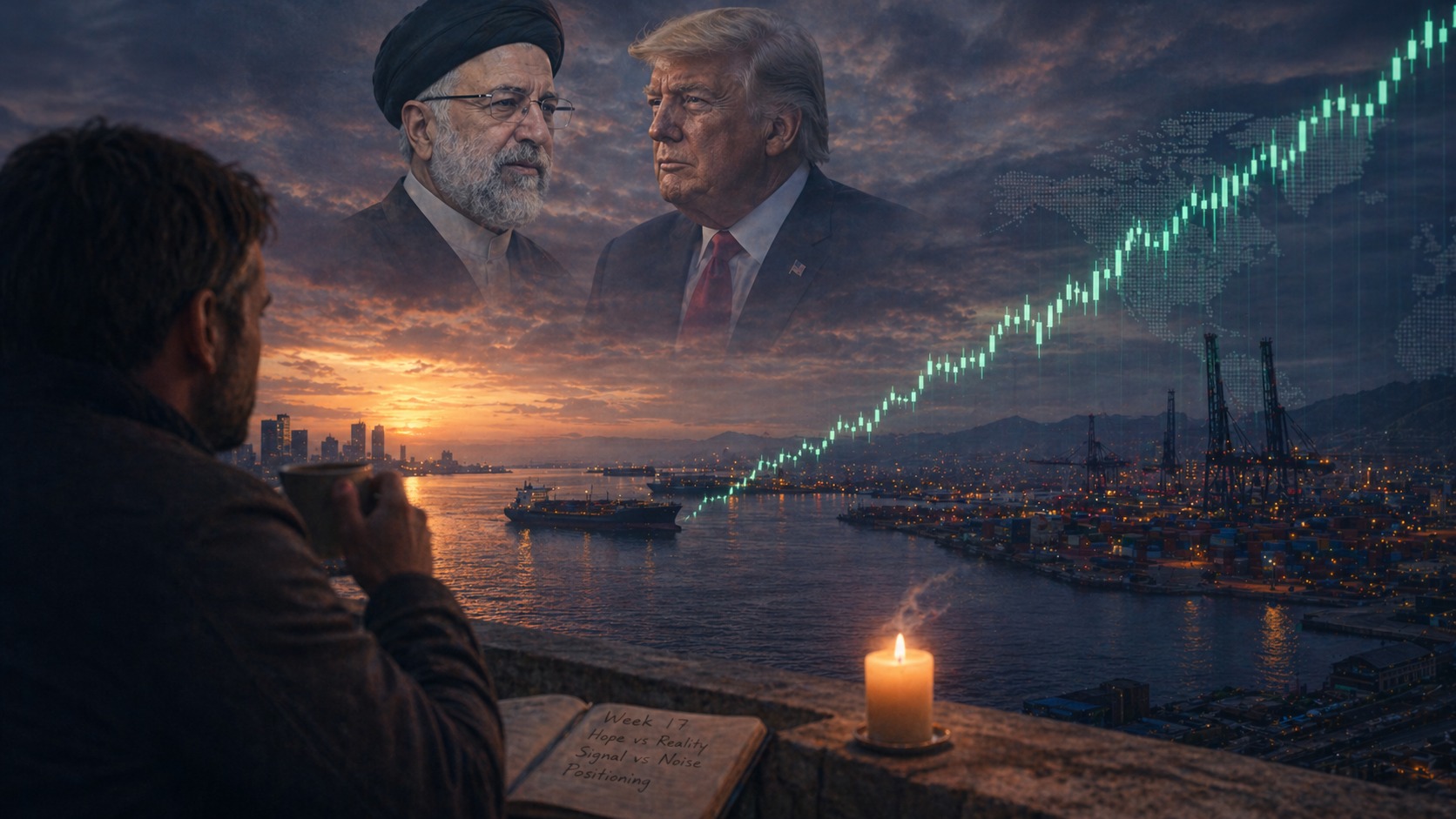
In February and March, the Iran war, a closed Hormuz and triple-digit oil forced everyone to think about chokepoints again. Week 16 brought relief as the strait reopened and oil fell; Week 17 kept the cast but changed the script. Trump extended the ceasefire “indefinitely” while blockades and gunfire incidents continued, earnings arrived stronger than expected, and the Fed’s higher-for-longer stance barely budged.
Espresso in hand, this week’s dispatch walks through three stories: a ceasefire extended but not yet trusted, records on Wall Street and in Tokyo with earnings doing the work, and a macro backdrop that keeps reminding us that the cost of time is still higher than our memories would like.
Let’s turn to the week.
Recap: Where We Left Off (Week 16)
We left Week 16 at what felt like a hinge point. Hormuz had reopened to commercial traffic under a two-week ceasefire, oil had surrendered much of its war spike, and global equities had responded with a full-throated relief rally. The S&P 500 and Nasdaq broke into fresh record territory, the Russell 2000 began to claw back some of its underperformance, and Europe rode the same wave as energy fears eased.
Gold, which had spent March charging higher as a policy-error and war hedge, paused in the mid-$4,500s per ounce, trading with more two-way interest than during the crisis weeks. Bitcoin, by contrast, behaved more like levered beta than ballast, bouncing with risk sentiment rather than hedging it. US yields held stubbornly in the low-4s for the 10-year and the high-3s for the 2-year, and the dollar gave back only a fraction of its conflict-driven gains.
The unresolved questions were threefold. Would the ceasefire hold long enough for oil and shipping to normalise, or was the sharp move down in crude just a headline-driven head fake? Could equity markets keep climbing the wall of worry as earnings season arrived, or would higher energy and higher real yields finally bite margins and multiples? And would central banks lean against easier financial conditions, or let asset prices absorb the relief while policy stayed put?
Week 17 did not give tidy answers, but it moved the story on. The ceasefire was extended but left deliberately vague, oil settled into a “high but not panicked” range, earnings arrived with enough strength to justify at least some of the optimism, and the Fed’s reaction function looked much the same: patient, wary, and unwilling to use one bad jobs print or one good ceasefire headline as an excuse to move.
If you missed last week’s dispatch, you can find it here: Week 16, 2026: Records, Re-Opening, and Risk Still Priced.
This Week: Fragile Peace, Record Highs, and the Cost of Time
Weekly Market Table
| Market | Week-end level | Weekly move | Year to date | Commentary |
|---|---|---|---|---|
| S&P 500 | 7,165.08 | +0.55% | +3.39% | fresh record on earnings and ceasefire hopes |
| Nasdaq Composite | 24,836.60 | +1.50% | +5.27% | semis and AI keep leadership intact |
| Russell 2000 | 2,787.00 | +0.36% | +9.97% | small caps finally join the party, balance sheets still a drag |
| FTSE 100 | 10,379.08 | -4.34% | +5.15% | off recent highs but still in record territory |
| STOXX Europe 600 | 610.65 | -1.51% | +3.74% | edges lower as Hormuz jitters offset earnings strength |
| Nikkei 225 | 59,716.18 | +3.85% | +17.77% | new highs again as Japan remains the global outlier |
| Hang Seng Index | 25,978.07 | -0.85% | +0.62% | quiet bid as China policy support slowly gains trust |
| Gold ($/oz) | $4,708.69 | +2.92% | +3.97% | drifts higher, still an expensive policy and war hedge |
| Bitcoin (BTCUSD) | $77,455.32 | +1.91% | -10.89% | high-beta expression of risk, not a safe haven |
| WTI Crude ($/bbl.) | $90.20 | +2.50% | +54.58% | holds near $90 as ceasefire relief meets chokepoint reality |
| US 10Y Treasury | 4.31% | -4 bps | +18 bps | stuck around 4.3%, higher-for-longer priced in |
| US 2Y Treasury | 3.78% | -7 bps | +30 bps | dips below 3.8% as near-term cut hopes creep back in |
| JPY 30Y Treasury | 3.65% | 0 bps | +24 bps | mid-3s keep Japan a real competitor for global duration |
| US Dollar Index (DXY) | 98.53 | +0.34% | +0.65% | a touch softer but still the cleanest dirty shirt |
Source: 2026-week-17-updated.xlsx, updated 26 April 2026. Closing data are for Friday 24 April 2026. Year-to-date comparisons use 2025 Week 52. Treasury yield changes are expressed in basis points rather than percentage returns.
US & Global Equities
- United States: US large caps pushed on to fresh record territory again. The S&P 500 closed at 7,165.08 as investors leaned into the extended Iran ceasefire, a calmer but still elevated oil tape, and Q1 earnings that beat expectations. The move looked less like a euphoric breakout and more like grudging acceptance that growth has, so far, absorbed higher energy and higher real yields better than feared.
- Technology: The Nasdaq set new highs on AI and semiconductor momentum. The Nasdaq Composite closed at 24,836.60, helped by a strong Intel print and continued demand for AI-related infrastructure. Cash-generative platforms and chipmakers remain the preferred way to own growth, even with a higher-for-longer rate backdrop.
- Small caps: The Russell 2000 finished at 2,787.00. The rally suggests the worst-case rate-and-recession scenario has been pushed out, but the index’s distance from prior-cycle highs still shows selectivity around balance-sheet quality.
- Europe and Asia: Europe shifted from ceasefire surge to consolidation, while Japan stayed at the top of the leaderboard. The Nikkei closed at 59,716.18, supported by fiscal stimulus, gradual BoJ normalisation and a weak yen. Hong Kong held a quieter bid as policy support from Beijing slowly gained trust.
Gold, Digital Assets and Other Assets
- Gold: Gold closed at $4,708.69, up 2.92% for the week. The tape looked less like a panic spike and more like a standing premium for a world that has learned how quickly chokepoints can close and how slowly central banks may respond if energy-driven inflation flares.
- Bitcoin: Bitcoin finished near $77,455, up 1.91% for the week but still down 10.89% year to date. Moves tracked risk sentiment more than war headlines or inflation expectations, reinforcing its behaviour as a high-beta liquidity asset rather than ballast.
- Oil: WTI ended around $90.20, up 2.50% for the week and more than 54% year to date. The extended ceasefire trimmed the front-end war premium, but shipping incidents, residual blockades and Tehran’s leverage over Hormuz kept a durable risk premium embedded in prices.
Macro & Policy
- US yields: The 10-year Treasury ended the week at 4.31% and the 2-year at 3.78%. Both eased modestly from Week 16, but the broader message remained higher for longer. With PCE near 2.8%, core around 3.0%, unemployment in the low-4s and no clear break in growth, the Fed had little incentive to rush into cuts.
- Dollar: DXY closed at 98.53, modestly firmer on the week. Softer oil and solid non-US equity performance encouraged some rotation into Europe and Japan, but US real yields continued to support the dollar’s safe-haven role.
- Japan: The 30-year JGB yield held at 3.65%, cementing the shift from “free yen duration” to Japanese paper as real competition for global fixed-income capital.
- The cost of time: Between a patient Fed, an oil market that refuses to return to old comfort levels and still-resilient growth, the cost of time remains structurally above the post-GFC norm. That raises the hurdle rate for every long-duration allocation decision.
Geopolitical Analysis
- Hormuz: The narrative shifted from “Hormuz reopened” to “ceasefire extended, but fragile.” The indefinite truce, Iran’s rejection of further talks and reports of gunfire against container ships all landed against a backdrop of only partially normalised shipping.
- Hope versus reality: Markets removed part of the immediate war premium but did not price full normalisation. Oil stayed near $90 and gold remained close to record territory, suggesting that investors saw the ceasefire as useful signalling rather than settled reality.
- Chokepoints as a regime: The market lesson is no longer simply whether a strategic strait is open or closed. The recurring possibility of disruption now sits inside freight, insurance, energy and inflation pricing as a standing risk premium.
What's Pertinent This Week (Week 17)?
Records are being earned, not merely hoped for. The S&P 500 and Nasdaq moved to fresh highs as Q1 earnings growth tracked strongly and semiconductor and AI-linked names continued to deliver. For capital allocation, that matters because earnings are doing more of the work than lower-rate expectations, even while richer valuations raise the hurdle for new money.
The ceasefire repriced the war premium rather than removing it. WTI held near $90 and gold remained elevated as shipping through Hormuz stayed only partially normalised. The capital-allocation implication is straightforward: energy, freight and route concentration still deserve an explicit risk premium rather than being treated as temporary noise.
The cost of time remains the slow-burn constraint. A 10-year yield around 4.3% and a 2-year near 3.8% are no longer shock levels, but they continue to shape discount rates, refinancing economics and relative value. The risk is less a sudden rates spike than a long period of mildly uncomfortable funding costs.
What Will Week 18 Bring?
Diplomacy and Hormuz
Any move from an “indefinite ceasefire” toward a more formal framework for Hormuz traffic, including credible shipping guarantees and clearer sanctions ground rules, could reduce the standing risk premium. A renewed blockade, fresh strikes or a high-profile shipping incident would quickly reverse much of April’s relief.
Earnings and macro prints
Q1 results move deeper into the corporate universe, while US inflation, PMIs and confidence data will test the “resilient but not overheating” narrative that currently supports higher-for-longer policy.
Other catalysts:
Fed communication, the dollar, freight and insurance pricing, and the day-to-day path of oil all have the capacity to challenge current pricing. The interaction matters more than any single headline.
Strategic positioning:
Optionality remains valuable. Strong balance sheets, genuine pricing power and manageable refinancing needs deserve preference while energy and shipping risks stay elevated. Long-duration assets remain sensitive to rates even if those rates now feel familiar rather than exceptional.
Ed's Closing Bell
Back on the Rock, the Sunday picture has not changed much. Ferries still cross to Algeciras, tourists are still deciding whether the monkeys are charming or menacing, and the waitress still raises an eyebrow when you ask for a fourth espresso. From here, the Strait looks like a straight line: grey-blue water, North Africa on the horizon, no visible drama.
The thing about straits, though, is that they compress everything: ships, weather and politics into a narrow channel. Hormuz has been reminding us of that all spring. One closure, one badly worded ultimatum, one “indefinite” ceasefire with clauses nobody fully agrees on, and the system must reroute energy, reprice shipping and rethink its inflation story.
Markets, for now, have chosen to live with it. Records on the screen, earnings doing their job, gold steady rather than screaming, and rates that feel high but no longer exotic add up to an uneasy truce between hope and arithmetic. Relief is real. Resolution is not.
Final Words
As ever, these are personal reflections intended to provoke thought, not investment advice. Straight lines on a map can conceal some very crooked currents, and markets have a habit of making tidy narratives look untidy very quickly.
Please conduct your own research and seek appropriate professional advice before making investment decisions.
From Gibraltar
When a ceasefire extends and indices hit records, the real risk is not missing the rally; it is forgetting how quickly the tide can turn.
Further Reading
- FactSet: S&P 500 Earnings Season Update, April 24, 2026
- FactSet: S&P 500 Earnings Season Update, April 17, 2026
- Reuters: Global markets surge as Iran says Strait of Hormuz fully open during ceasefire
- Gotrade: Iran Ceasefire Extended but Hormuz Tensions Rattle Markets
- Reuters: Stocks end higher on ceasefire relief, oil gains as truce is tested
- Economic Weekly: April 24, 2026
- U.S. Bank: April 2026 U.S. Economic Outlook
- Morningstar / MarketWatch: April's stock-market rebound faces its first major earnings test
- Investing.com: US Dollar Index historical data
Full Disclaimer
The views expressed in this blog are my own personal market observations and reflections. They do not constitute investment advice, a financial promotion, or a recommendation to buy or sell any security. This publication is not made in my capacity as a director of Quay Financials (Gibraltar) Limited, which is authorised and regulated by the Gibraltar Financial Services Commission. You should always conduct your own research and seek independent advice appropriate to your circumstances before making any investment decision.
Information has been obtained from sources believed to be reliable, but no representation or warranty is given as to its accuracy, completeness or timeliness. Market levels and weekly changes are compiled from the Week 17 market workbook updated on 26 April 2026 and public market data available for the close on 24 April 2026, and may vary by venue, instrument and closing convention. The value of investments and the income derived from them may fall as well as rise, and investors may not recover the amount originally invested. Past performance is not a reliable indicator of future results. Readers should conduct their own research and obtain independent professional advice appropriate to their circumstances before making an investment decision.
