The views expressed are Ed le Feuvre's personal market observations and do not constitute investment advice, a financial promotion or a recommendation to buy or sell any security. Read the full disclaimer.
Dear Quay Financials
Sunday morning on the Rock, and the Strait is doing its usual trick of looking calmer than the week it just framed. May has started and the first tourists are negotiating with café tables and seagulls for ownership of the view. If you kept your eyes on the water, you could almost believe the world has remembered how to behave.
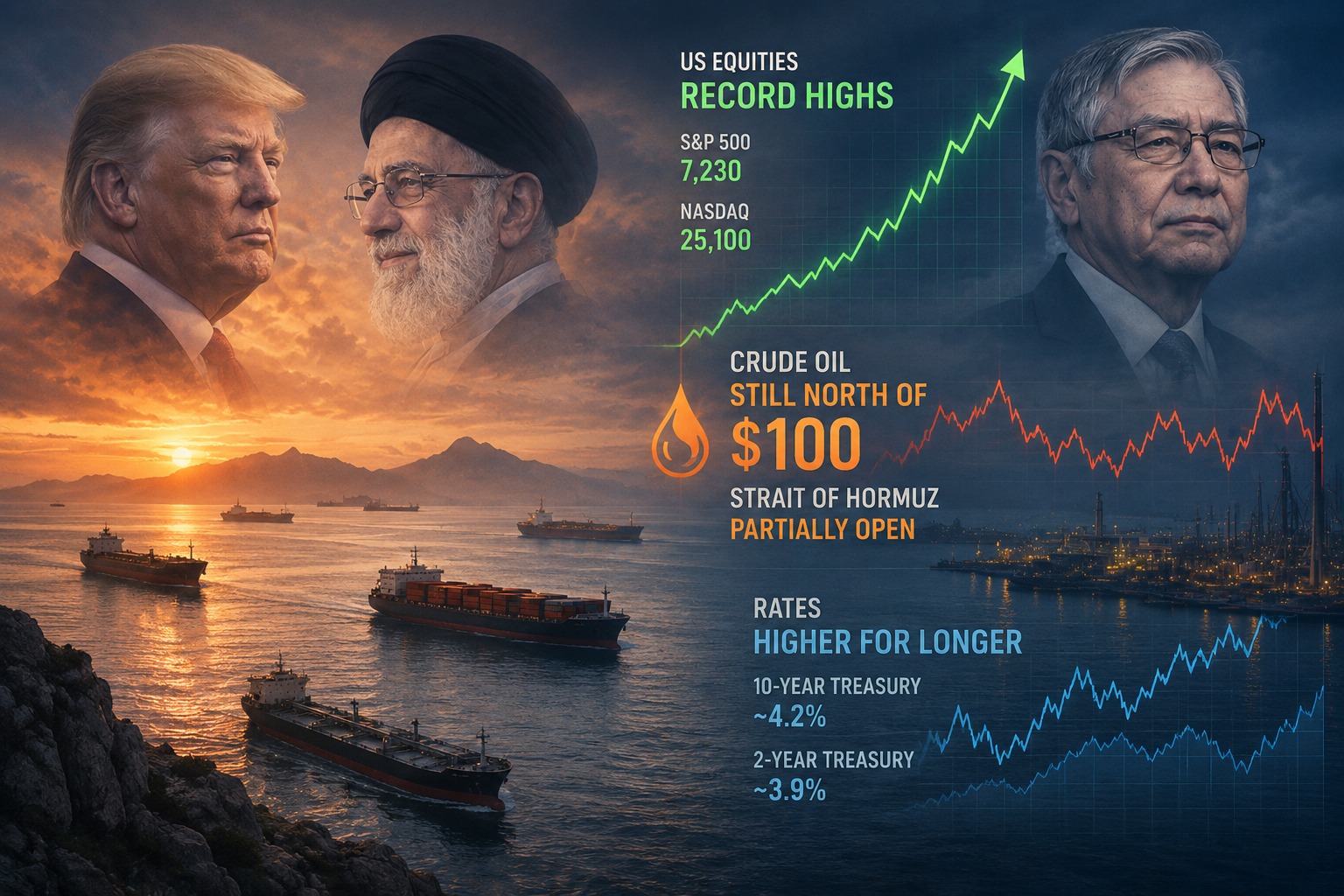
But the trading screens disagree. One shows the S&P 500 and Nasdaq closing out another week at record highs, led once again by AI, semiconductors and the platforms that rent out the digital picks and shovels. Another tracks crude still north of $100, courtesy of a Strait of Hormuz that is "negotiating" reopening at roughly the pace oil tankers cannot sail. A third is stuck on rates: 10-year Treasuries around 4.4%, 2-years close to 3.9%, and a Fed politely reminding everyone that "higher for longer" is not a slogan but a plan.
Week 18 did not change the cast; it moved the plot a notch further. Equities leaned into earnings and AI again, oil stayed in "energy tax, not apocalypse" territory, and the cost of time remained stubbornly expensive.
Let’s turn to the week.
Recap: Where We Left Off (Week 17)
Week 17 ended under the banner of fragile peace, record highs and the cost of time. The Iran ceasefire had been described as indefinite, yet shipping incidents and blockades kept Hormuz only partially open. Oil remained high but short of panic territory, while gold stayed near record levels as a hedge against policy error and chokepoint risk.
US equities used that uneasy backdrop to make new highs. The S&P 500 and Nasdaq pushed further into record territory on stronger-than-expected Q1 earnings, especially in AI-linked semiconductors and platforms. The Russell 2000 finally rejoined the move from below prior-cycle peaks, while Europe consolidated and Japan’s Nikkei flirted with 60,000.
The unresolved question was whether equities could keep climbing with both oil and the cost of time elevated. Week 18 answered, for now, with another set of records. What did not materialise was a clean normalisation in energy or rates. Oil moved back above $100 and Fed easing expectations were pushed further out.
This Week: ATH Records Again, Oil Still Costly, Time Still Expensive
Weekly Market Table
| Market | Week-end level | Weekly move | Year to date |
|---|---|---|---|
| S&P 500 | 7,230 | +0.91% | +4.33% |
| Nasdaq Composite | 25,114 | +1.12% | +6.45% |
| Russell 2000 | 2,813 | +0.93% | +10.99% |
| FTSE 100 | 10,364 | -0.15% | +5.00% |
| STOXX Europe 600 | 611 | +0.10% | +3.85% |
| Nikkei 225 | 59,513 | -0.34% | +17.37% |
| Hang Seng Index | 25,117 | -3.32% | -2.72% |
| Gold ($/oz) | $4,627 | -1.73% | +2.17% |
| Bitcoin | $77,800 | +0.45% | -10.50% |
| WTI crude | $101.94 | +13.02% | +74.70% |
| US 10-year Treasury yield | 4.39% | +1.86% | +6.30% |
| US 2-year Treasury yield | 3.88% | +2.65% | +11.49% |
| Japan 30-year Treasury yield | 3.72% | +1.92% | +9.09% |
| US Dollar Index (DXY) | 98.2 | -0.35% | +0.31% |
Snapshot using Friday 1 May 2026, or the last trading day where local markets were closed. Treasury and JGB weekly and year-to-date figures are percentage changes in the quoted yields, as presented in the source table, rather than bond total returns.
US & Global Equities
- US large caps: The S&P 500 added roughly 0.9% to close near 7,230. Another round of AI- and cloud-heavy earnings beats, plus still-solid macro data, kept the soft-landing narrative intact. The tone was more grudging acceptance than euphoric melt-up: earnings are still carrying the load.
- Nasdaq: The Nasdaq Composite climbed about 1.1% to just over 25,100, setting fresh highs as semiconductors, hyperscalers and software platforms continued to attract flows. Investors remained willing to pay for cash-generative growth even with rates in a 4-handle world.
- Small caps: The Russell 2000 gained just under 1%, its second week of keeping pace with large caps rather than lagging them. For an index heavy in floating-rate debt and 2026-27 maturities, that resilience suggests the market has pushed the worst-case rate-and-recession scenario further out.
- Europe and Asia: The STOXX 600 edged 0.1% higher while the FTSE 100 slipped 0.15%. Japan paused near the top of the screen as the Nikkei dipped 0.34%, while Hong Kong’s Hang Seng fell 3.32% as optimism around Chinese easing and stimulus faded.
Gold, Digital Assets and Other Assets
- Gold: Bullion slipped 1.73% to roughly $4,627 per ounce, still close to record territory. The move looked more like profit-taking against renewed equity strength than an unwind of the broader policy-error and chokepoint premium.
- Bitcoin: BTC finished around $77,800, up 0.45% on the week. Intraday moves tracked risk sentiment and liquidity more closely than war headlines or inflation data, reinforcing its behaviour as a high-beta liquidity asset rather than portfolio ballast.
- Oil: WTI rose 13.02% to $101.94 after trading around $106 earlier in the week. The split between tight physical markets and lagging futures has become increasingly important, with the oil story moving from short-lived shock toward persistent energy tax.
- Rates and the dollar: The US 10-year yield ended around 4.39%, the 2-year around 3.88%, and DXY slipped 0.35% to 98.2. The combination remains uncomfortable but familiar: expensive money, a resilient dollar and little urgency for policy easing.
- Japan’s long end: The 30-year JGB yield sat near 3.72%, cementing the end of "free yen duration" and turning Japanese government bonds into genuine competition for global fixed-income capital.
Macro & Policy
- Federal Reserve: Powell’s late-April press conference reinforced a cautious, data-dependent stance. With the funds rate at 3.50-3.75%, markets sharply reduced the probability of a cut by the June or July meetings.
- Higher for longer: Futures and economists increasingly converged on one late-2026 cut at best, with some expectations pushed into 2027. That repricing matters more for long-duration assets and leveraged capital structures than the next few points on the S&P 500.
- Energy constrains policy: Higher oil is being treated as an explicit upside risk to inflation. The ECB faces the same awkward mix of elevated energy costs and fragile growth, limiting the room for aggressive easing.
- Japan: The BoJ continues to normalise carefully while long JGB yields rise. The global relevance is the carry trade: a visibly positive return on yen duration changes the relative attractiveness of funding and asset allocation well beyond Japan.
Geopolitical Analysis
- Hormuz: Nine weeks into the 2026 crisis, vessel traffic through the Strait remained heavily disrupted. Emergency reserve releases and pipeline rerouting bought time, but they did not remove the physical constraint.
- Shock becomes regime: Oil markets increasingly treated the disruption as structural risk rather than a tail event. The language shifted from "spike" and "shock" toward "energy tax" and "structural chokepoint".
- Second-order effects: Petrochemicals, aviation fuel and freight moved further into the discussion. The market implication is increasingly about supply chains, storage, rerouting and substitution rather than simply owning energy beta.
What's Pertinent This Week (Week 18)?
AI and earnings are still doing the heavy lifting. Record closes in the S&P 500 and Nasdaq were supported by earnings and AI capex rather than hopes of imminent rate cuts. For capital allocation, that distinction matters: the market is rewarding realised cash generation while the discount rate remains demanding.
Oil is becoming a persistent energy tax. WTI back above $100 means the transmission mechanism now runs through inflation, freight, margins and policy. The relevant distinction is less "risk-on versus risk-off" and more who can pass through higher energy costs and who cannot.
Global hurdle rates are resetting. US yields in the low 4s and Japan’s 30-year yield in the high 3s challenge capital structures and valuation assumptions built on a rapid return to post-GFC money. More of the return now has to come from genuine growth and operational performance rather than falling discount rates.
What Will Week 19 Bring?
Other catalysts:
Hormuz reopening headlines, physical oil flows, the next round of AI and earnings commentary, US inflation expectations and the continued behaviour of Japan’s long end all have the capacity to challenge current pricing. The key interaction remains the same: persistent energy pressure makes it harder for central banks to offer relief, while stronger earnings allow equities to tolerate that pressure for longer.
Strategic positioning:
Optionality remains valuable. Cash and short-duration assets now pay a visible return, while equity exposure favours strong balance sheets, pricing power and businesses less dependent on cheap refinancing. The main discipline is to avoid building a portfolio around the assumption that the cost of capital quickly returns to the world of the last decade.
Ed's Closing Bell
Walk back down Main Street on a Sunday and the Strait of Gibraltar looks as composed as ever. Ferries trace straight lines to Algeciras, a container ship or two loiters off Europa Point, and the only visible volatility is the queue for gelato. It is the kind of scene that tempts you to take record highs and "manageable" shocks at face value.
Markets tell a more complicated story. Record equity indices are real; so is triple-digit oil. A Fed reluctant to cut into an energy shock is real; so is a JGB curve whose long end now begins with a three. None is a crisis on its own. Together, they say that the subsidy of cheap energy and cheaper time that defined the last cycle has expired.
For now, the currents matter more than the surface. Pricing power, refinancing resilience and the opportunity cost of capital deserve as much attention as the latest index record.
Final Words
As ever, these reflections are my own and are intended to provoke thought, not to provide investment advice. Markets have a reliable habit of humbling certainty, particularly when energy, monetary policy and geopolitical risk arrive at the same time.
Please conduct your own research and seek appropriate professional advice before making investment decisions.
From Gibraltar
Calm straits can hide expensive currents, and the price of time is now one of them.
Further Reading
- Yahoo Finance – Stock Market News for May 1, 2026
- Trading Economics – United States Stock Market Index
- Lance Roberts – Bull Bear Report: Week of May 1, 2026
- Reuters – Investors are running out of time to brace for true oil shock
- Bloomberg – The Strait of Hormuz Oil Shock Is Now Heading West
- Cryptobriefing – Oil price hits $110 as Strait of Hormuz closure impacts global flows
- Capital.com – Crude Oil Price Forecast: US-Iran Talks, Hormuz Flows
- Cryptobriefing – Powell signals cautious Fed stance, lowering rate cut expectations through 2026
- Yahoo Finance – The Fed was expected to cut rates in 2026 but a new inflation shock changed that
- Morningstar – As Powell Closes Out Term as Fed Chair, Odds of Rate Cut in 2026 Vanish
- Binance Square – Japan’s 30-Year Bond Yield Surges to Record-High ~3.48%
- Yahoo Finance – Japan’s Record Bond Yields Put Yen Carry Trade Back in Focus
- Equiti – BoJ policies and higher yields add pressure to carry trades
Full Disclaimer
The views expressed in this blog are my own personal market observations and reflections. They do not constitute investment advice, a financial promotion, or a recommendation to buy or sell any security. This publication is not made in my capacity as a director of Quay Financials (Gibraltar) Limited, which is authorised and regulated by the Gibraltar Financial Services Commission. You should always conduct your own research and seek independent advice appropriate to your circumstances before making any investment decision.
Information has been obtained from sources believed to be reliable, but no representation or warranty is given as to its accuracy, completeness or timeliness. Market levels and weekly changes are compiled from the Week 18 source material for the week ended 1 May 2026 and may vary by venue, instrument and closing convention. The value of investments and the income derived from them may fall as well as rise, and investors may not recover the amount originally invested. Past performance is not a reliable indicator of future results. Readers should conduct their own research and obtain independent professional advice appropriate to their circumstances before making an investment decision.
