The views expressed are Ed le Feuvre's personal market observations and do not constitute investment advice, a financial promotion or a recommendation to buy or sell any security. Read the full disclaimer.
Dear Quay Financials,
Sunday afternoon on the Rock, and the Strait is back to its favourite illusion: calm water, busy ships, and just enough sunlight off Algeciras to make it look as if the week never happened. The first May tourists are already negotiating with café tables and seagulls for ownership of the view. If you kept your eyes on the harbour, you could almost believe the world had decided to behave itself again.
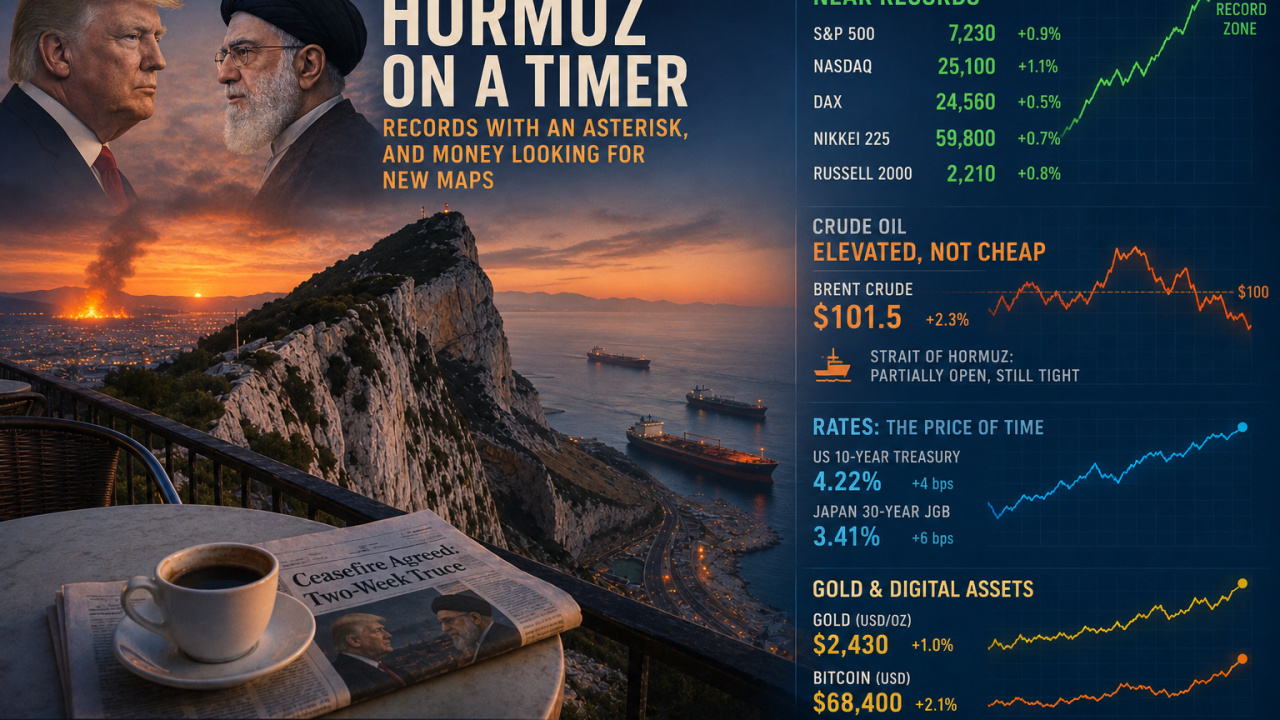
The screens say otherwise. One still loops the charts from April's ceasefire jump, when global equities surged as Washington and Tehran agreed to a two-week truce and oil fell from war-panic levels. Another reminds us that crude remains elevated, not cheap, because the Strait of Hormuz is only partially open. A third sits on the rates page, where ten-year Treasuries in the low-4s and Japanese 30-year bonds in the mid-3s have turned the price of time from metaphor into line item.
Week 19 did not introduce new characters; it pushed the existing story along. Markets continued to digest the ceasefire and partial reopening of Hormuz as a reprieve, not a reset. Equities hovered near or at records in the US, Europe and Japan, powered by the same AI-and-earnings engine that drove Week 18, but with more open discussion about how long indices can live with expensive energy and non-cheap money.
In the background, another conversation gathered volume. After a decade and a half of US exceptionalism, capital is starting to look more seriously at emerging markets and ex-US equities that are growing profits faster and, for once, are not charging a premium for the privilege. Espresso in hand, with the Levanter threatening to sneak back tonight, let's turn to the week.
Recap: Where We Left Off (Week 18)
Week 18 closed under the banner of records again, oil still costly, time still expensive. The S&P 500 and Nasdaq logged fresh record closes, led by AI, semiconductors and the platforms selling the digital picks and shovels, even as crude stayed around triple-digit levels and a cautious Fed reinforced that higher for longer was a plan rather than a press-conference flourish.
Large caps added roughly 0.9% to push the S&P 500 near 7,230, the Nasdaq climbed about 1.1% to just over 25,100, and the Russell 2000 managed another week of keeping pace rather than lagging. Europe edged higher but looked tired, while Japan's Nikkei hovered near 60,000 as foreign flows rediscovered Tokyo's blend of governance reform, a weak yen and now-non-trivial bond yields.
What did not materialise was a clean normalisation in energy or rates. Hormuz remained disrupted, the Fed showed little appetite to cut into an energy shock while growth stayed decent, and Japan's 30-year yield remained around the high-3s. The unresolved questions were whether ceasefire relief would endure, whether equities could keep climbing with expensive oil and expensive time, and whether the rotation towards non-US markets would become durable.
This Week: Hormuz on a Timer, Records with an Asterisk, and Money Looking for New Maps
Weekly Market Table
| Asset | Week 19 2026 Close | WoW | YTD | Comment |
|---|---|---|---|---|
| S&P 500 | 7,399 | 2.33% | 6.77% | Near highs as ceasefire relief meets still-expensive ‘price of time’. |
| Nasdaq Composite | 26,247 | 4.51% | 11.25% | New records on AI and cloud cashflows, but leadership remains painfully narrow. |
| Russell 2000 | 2,861 | 1.72% | 12.90% | Small caps still hostage to funding costs and energy, not just earnings narratives. |
| FTSE 100 | 10,233 | -1.26% | 3.67% | Enjoys cheaper oil and dividend bid, still priced for slow-growth Britain. |
| STOXX Europe 600 | 612 | 0.14% | 4.00% | Hugs the highs as Europe imports the soft-landing story and an oil reprieve. |
| Nikkei 225 | 62,174 | 4.47% | 22.62% | Keeps rewriting the record book on weak yen, reforms and a new cost of yen duration. |
| Hang Seng Index | 26,275 | 4.61% | 1.77% | Edges out of the penalty box as China policy support and global risk-on coexist uneasily. |
| Gold ($/oz) | 4,704 | 1.66% | 3.86% | Stays expensive as policy-error and war-headline hedge, not just an inflation story. |
| Bitcoin (BTCUSD) | 79,883 | 2.68% | -8.10% | Trades like high-beta tech, not ballast, a levered Nasdaq proxy in ceasefire mode. |
| WTI Crude ($/bbl.) | 97.00 | -4.85% | 66.24% | Well off the spike but still an energy tax, Hormuz risk premium now a range trade, not a panic. |
| US 10Y Treasury | 4.38% | -0.23% | 6.05% | Low-4s reminder that time is no longer free, equity rallies are paying a higher discount rate. |
| US 2Y Treasury | 3.90% | 0.52% | 12.07% | Front end prices ‘later and less’ cuts, curve less inverted, not yet comfortable. |
| JPY 30Y Treasury | 3.72% | 0.00% | 9.09% | Japan’s long end sitting in the 3s, finally competing with global credit for real. |
| US Dollar Index (DXY) | 97.8 | -0.36% | -0.05% | Drifts from haven highs as capital tiptoes back into Europe, Japan and EM. |
Figures reproduced exactly from the supplied Week 19 market table. No values have been recalculated or silently corrected.
US & Global Equities
- US large caps: The S&P 500 spent Week 19 consolidating around its recent record zone. Price action looked more like digestion than a fresh breakout, while commentary increasingly paired strong earnings with questions about margins, input costs and discount rates.
- Nasdaq: Leadership remained intact and concentrated. The Composite reached another record during the week as AI infrastructure, semiconductors and cloud names kept delivering, but every wobble in regulation, geopolitics or capex expectations exposed how narrow the leadership remains.
- Russell 2000: Small caps kept pace rather than falling away, suggesting investors have pushed the worst stagflation scenarios further out. The balance-sheet constraint remains visible, with floating-rate exposure and a busy 2026-27 refinancing pipeline making the cohort unusually sensitive to yields and energy.
- Europe: The FTSE 100 and STOXX 600 remained near recent highs, but the narrative is still more about dividends, defensives and an oil reprieve than growth acceleration. Imported energy costs and limited policy room continue to cap enthusiasm.
- Asia: Japan stayed near record territory as foreign flows and corporate reform offset the new cost of yen duration. Hong Kong and China continued to trade as a show-me market, where policy support can lift sentiment but weak follow-through quickly fades rallies.
Gold, Digital Assets and Other Assets
- Gold: Bullion remained expensive and close to crisis-era highs, behaving as a hedge against policy error and geopolitical accidents rather than simply as an inflation trade.
- Bitcoin: Crypto traded like leveraged risk appetite. The Week 19 table shows Bitcoin at $79,883, up 2.68% on the week but still down 8.10% year to date, reinforcing its role as high-beta tech rather than portfolio ballast in this episode.
- Oil: WTI closed at $97.00 after falling 4.85% on the week. The panic premium has receded, but the market has settled into an uncomfortable high range where Hormuz disruption still behaves like a structural energy tax.
- Dollar: The DXY ended at 97.8, down 0.36% on the week, as capital cautiously rotated back towards Europe, Japan and emerging markets.
Macro & Policy
- Federal Reserve: The ceasefire bought breathing space, not a rate-cut catalyst. Fed commentary continued to treat lower oil relative to the panic peak as welcome, while resisting the idea that this alone justifies easier policy with growth still solid and inflation risk unresolved.
- Higher for longer: US 10-year yields remained in the low-4s and the 2-year near 3.90%. The market is slowly internalising that expensive time is the base case, increasing the burden on actual cash-flow generation rather than multiple expansion.
- Japan: The 30-year JGB yield at 3.72% is no longer a curiosity. Japanese sovereign duration now competes with global credit for domestic capital, forcing a rethink of carry trades, hurdle rates and cross-border allocation.
- Europe: The ECB remains constrained by brittle growth and expensive imported energy, while the BoJ continues to normalise cautiously in an effort to avoid disorderly carry-trade unwinds.
Geopolitical Analysis
- Hormuz: The shift is from headline shock to structural risk. Traffic through the Strait has improved but remains far from normal, leaving a meaningful share of global oil flows exposed to political negotiation and military posture.
- The ceasefire timer: Markets treated the two-week US-Iran truce as genuine relief, but not resolution. Oil fell sharply from panic levels and equities rallied, while the calendar attached to the agreement kept a residual war premium embedded in energy and volatility.
- Chokepoints: Hormuz now sits alongside the Red Sea, Suez, critical rail hubs and undersea data cables as infrastructure where a single incident can reprice trade routes and risk premia quickly. Markets are increasingly treating resilience around these points as an economic variable in its own right.
What's Pertinent This Week (Week 19)?
Hormuz is becoming a regime, not a headline. The ceasefire and partial reopening cut the panic premium, yet WTI at $97.00 still represents an expensive energy tax. For capital allocation, the distinction matters: the more durable opportunity sits in resilience, storage, logistics, hedging capacity and efficiency rather than simply owning directional oil beta.
Record highs now carry a higher hurdle. Equities are being supported by earnings and AI cashflows while ten-year Treasuries sit in the low-4s and Japan's long end yields in the 3s. The implication is straightforward: more of the return must come from genuine operating performance because the discount-rate tailwind is smaller.
Money is beginning to draw new maps. Emerging markets and ex-US equities are attracting attention after years of US dominance, helped by stronger profit growth and less demanding valuations. This matters because persistent home bias is becoming a more expensive assumption when viable alternatives now offer both growth and visible yield.
What Will Week 20 Bring?
Other catalysts:
The most credible challenges to current pricing remain the ceasefire timetable, physical shipping through Hormuz, crude's ability to hold below panic levels, the next round of AI and earnings commentary, US inflation expectations, and the behaviour of Japan's long end. Any one of those can test the uneasy coexistence of record equities and expensive time.
Strategic positioning:
Optionality remains useful. Cash and short-duration assets now pay a visible return, while equity exposure still favours strong balance sheets, pricing power and businesses able to grow without relying on cheap refinancing. Geographic diversification deserves more attention as capital begins to test markets beyond the US, while energy and rates remain the main constraints on exuberance.
Ed's Closing Bell
Walk back down Main Street on a Sunday evening and the Strait of Gibraltar looks exactly as it does in the tourist brochures. Ferries draw neat diagonals across to Algeciras, a couple of container ships take their time rounding Europa Point, and children on scooters outnumber traders on their phones. It is the kind of scene that makes it dangerously easy to take ceasefire headlines and record-high stories at face value.
Markets are less forgiving. The Iran ceasefire is real, but it comes with a timer. Oil has dropped from its war-panic peaks, but it remains an expensive tax on anyone who needs to move goods or fuel aircraft. Equities are high because earnings and AI spending are carrying more of the load, not because the cost of capital has quietly disappeared.
From a small table on the Rock, the lesson feels familiar. Calm water does not mean simple currents. Portfolios built on assumptions of cheap energy, cheaper time and permanent US dominance are discovering that each of those subsidies was temporary. The task is not to predict every current, but to know which assumptions are carrying too much weight.
Final Words
As ever, these reflections are my own and are no substitute for your own homework or a proper conversation with someone who understands your circumstances. Treat this ceasefire and these records as an invitation to tidy assumptions, not as permission to stop asking what could change.
Please conduct your own research and seek appropriate independent professional advice before making investment decisions.
From Gibraltar
When ceasefires, record highs and rotation all arrive in the same fortnight, the real risk is not missing the rally; it is forgetting how quickly the tide can turn.
Further Reading
- Reuters – Wall Street ends sharply higher on US-Iran ceasefire
- LA Times – Oil prices sink, stocks jump as U.S.–Iran agree to ceasefire
- Al Jazeera – Oil prices slide, stocks surge as Trump announces two-week Iran ceasefire
- IG – US-Iran ceasefire: market impact and what comes next
- Morningstar / Dow Jones – NASDAQ Composite Rises 1.03% to 25,326.13, 9th Record Close of 2026
- CNBC – Stock market today: Live updates
- Prospera Capital – Global markets reach record highs on easing tensions and Hormuz reopening
- Yahoo Finance / Prof G Markets – Scott Galloway is moving his money overseas as the gap between global and U.S. markets is unusually wide
- Global Economic Daily – 13/04/2026
- Ed's World Market Insights – Week 17, 2026: Fragile Peace, Record Highs, and the Cost of Time
Full Disclaimer
The views expressed in this blog are my own personal market observations and reflections. They do not constitute investment advice, a financial promotion, or a recommendation to buy or sell any security. This publication is not made in my capacity as a director of Quay Financials (Gibraltar) Limited, which is authorised and regulated by the Gibraltar Financial Services Commission. You should always conduct your own research and seek independent advice appropriate to your circumstances before making any investment decision.
Information has been obtained from sources believed to be reliable, but no representation or warranty is given as to its accuracy, completeness or timeliness. Market levels and weekly changes are compiled from the Week 19 source material for the week ended 8 May 2026 and may vary by venue, instrument and closing convention. The value of investments and the income derived from them may fall as well as rise, and investors may not recover the amount originally invested. Past performance is not a reliable indicator of future results. Readers should conduct their own research and obtain independent professional advice appropriate to their circumstances before making an investment decision.
