
Archive edition: Week 24, 2025. The commentary and figures reflect the original publication period, not current market conditions. These are Ed le Feuvre's personal observations, not investment advice. Read the full disclaimer.
Dear Quay Financials,
Ever feel like you’re watching the same movie on repeat, except the plot twists keep getting wilder? That’s how markets have felt lately. Just when you think you’ve seen every possible surprise, the script flips again. This week, the headlines served up a double feature: geopolitical drama and a very sobering tragedy, both with real consequences for investors.
So… grab your favourite drink… be it a double espresso, a grappa with water (no ice, naturally), or something equally fortifying and settle in. We’re about to unpack the week’s most important developments, and why staying nimble is more than just good advice… it’s essential for navigating this unpredictable market.
Recap: Where We Left Off (Week 23)
Last week, we saw the Trump-Musk feud rattle tech stocks, oil prices were steady, and central banks kept everyone guessing. The mood was cautiously optimistic, but as always, the market was one headline away from a mood swing.
Markets are like brunch: just when you think you’ve got the menu figured out, someone orders the special and changes the whole vibe. Last week’s drama was a reminder that no matter how much you plan, the unexpected always finds a way to the table.
This Week: Oil Shocks, Air Tragedies, and Market Jitters
US & Global Equities:
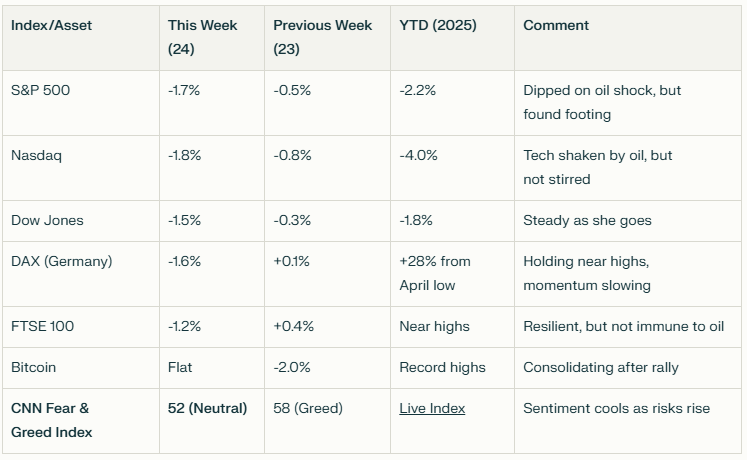
- S&P 500 and Nasdaq dipped sharply on Friday as tensions between Israel and Iran flared, with oil prices surging and investors flocking to safe havens.
- FTSE 100 and DAX (Germany) also retreated, though less dramatically, as European markets weighed the risk of a broader Middle East conflict.
- Bitcoin was volatile but ended the week flat, proving once again that digital gold can be as unpredictable as a brunch guest who insists on ordering dessert first.
Macro & Policy:
- US Treasury yields edged higher as investors priced in the risk of sustained inflation from rising oil prices.
- Fed officials remained cautious, with the market now pricing in a September rate cut, but the path remains uncertain.
- China’s manufacturing PMI remained in contraction, but hopes for a tariff thaw kept sentiment from souring further.
- Europe & UK: The ECB and BoE are both in easing mode, but inflation and geopolitical risks are keeping policymakers cautious.
Economic Analysis:
The Israel-Iran Attack
The week’s biggest shock came as Israel launched strikes on nuclear and military sites in Iran, sending oil prices soaring and stocks tumbling. Brent crude surged as much as 14% before settling up 7% for the week, while WTI crude followed suit. The immediate market reaction was a flight to safety: equities fell across Asia, Europe, and the US.
Market Impact:
- Oil prices: The spike in oil prices is expected to feed through to inflation, with the IMF estimating that every 10% rise in oil prices adds about 0.4 percentage points to inflation in advanced economies.
- Shipping and trade: Insurance premiums for shipping in the region have risen, and any disruption to key waterways could further strain global supply chains.
- Growth outlook: The risk of a wider conflict has added uncertainty to an already fragile global growth environment, with potential knock-on effects for business investment and consumer confidence.
With inflationary pressure increasing the likelihood of interest rate dropping declines and this will lead to constrained risk asset growth. (see the interest rate piece below).
The Israel-Iran attack feels like a brunch guest spilling red wine on the tablecloth; sudden, messy, and impossible to ignore. Markets hate surprises, especially when they come with a side of oil inflation. The lesson? Always keep a napkin (or a hedge) handy.
The Air India Crash
The tragic crash of Air India Flight 171 has sent shockwaves through the aviation industry and the broader Indian economy. The disaster, which claimed over 200 lives, is the deadliest civil aviation accident in India this decade and the first fatal hull loss for the Boeing 787.
On behalf of Quay Financials, I would like to express my deepest sympathies to all those affected by this terrible tragedy. Our thoughts are with the families, friends, and colleagues of the victims.
Market and Sector Impact:
- Airline and aerospace stocks: Boeing and Air India shares fell sharply, and the incident has raised fresh concerns about safety, maintenance, and the challenges facing India’s rapidly growing aviation sector.
- Industry challenges: The crash comes at a time when Indian airlines are already grappling with grounded planes, engine failures, and labour disputes. The Tata Group’s ambitious plans to modernize Air India now face renewed scrutiny.
- Broader implications: The tragedy underscores the fragility of India’s aviation boom and the importance of operational discipline, safety culture, and financial resilience in a high-growth, high-risk environment.
The Air India crash is a sobering reminder that even the most ambitious growth stories can be derailed by a single moment of tragedy. In markets and in life, it’s not just about how fast you grow. It’s about how well you manage risk along the way.
Weekly Market Table
What’s Pertinent This Week?
- Central Bank Watch: The Fed, ECB, and BoE are all in easing mode, but geopolitical and inflation risks are keeping policymakers cautious. No interest rate reductions for the FOMC next week.
- Oil Shock: The Israel-Iran attack has reignited fears of sustained inflation and slower growth, with oil prices surging and shipping costs rising.
- Aviation Tragedy: The Air India crash has shaken confidence in the sector and highlighted the challenges of managing rapid growth in a high-risk industry.
- Global Growth: China’s manufacturing PMI remains weak, but hopes for a tariff thaw are keeping sentiment from souring further. Europe and the UK are showing slow but positive momentum.
This week was a reminder that markets are as much about psychology as they are about fundamentals. The Israel-Iran attack and the Air India crash were like two uninvited guests at brunch…. sudden, disruptive, and impossible to ignore.
The key takeaway? Keep your portfolio balanced and your sense of humour intact.
Private Equity’s Macro Insights:
Interest Rates and Monetary Policy: The Summer Forecast
Interest rates are beginning to drop. The U.S. Federal Reserve, having held rates steady at 4.25–4.50%, now foresees two cuts by year-end, potentially bringing the target range down to 3.75–4.00%. The European Central Bank and Bank of England are also in easing mode, citing inflation under control and a cautiously optimistic outlook for growth. Below is a chart showing the post summer interest rate probabilities.
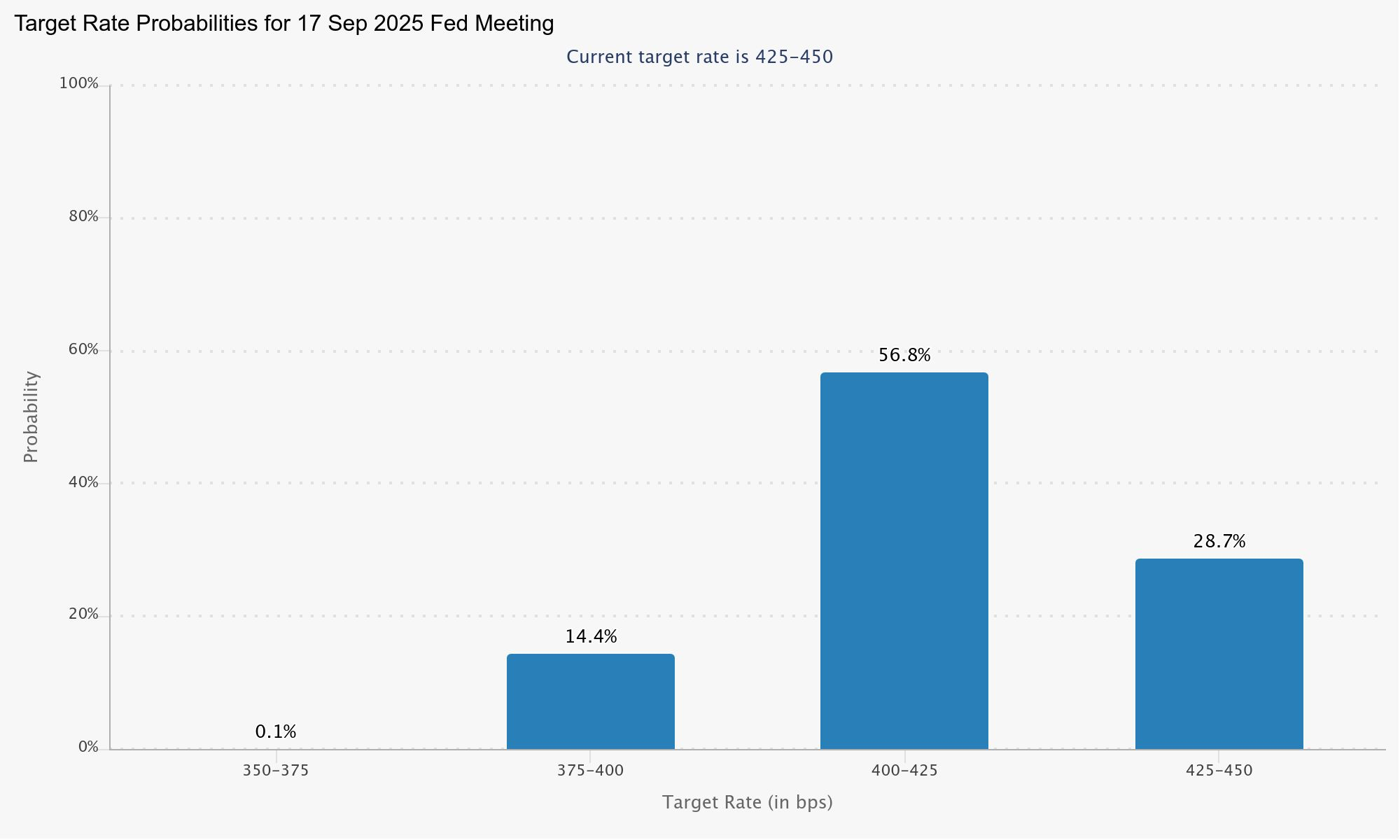
This marks a clear pivot from restrictive to neutral or even accommodative policy, as central banks seek to avoid a sudden cooling of the labour market and keep the economy on track.
For private equity, lower rates mean cheaper financing for buyers, higher valuations, and a more receptive environment for exits; especially IPOs and mergers.
Over the next three weeks, we will take a deeper educational dive into the mechanics of interest rates and their impact on private equity exits. Expect practical insights, real-world examples, and actionable strategies for navigating the evolving rate environment.
Monetary Liquidity: The Hidden Tailwind
Monetary policy and liquidity conditions have already moved favourably. The U.S. M2 money supply has climbed to a record $22 trillion in April 2025, signalling the end of tightening and a return to monetary expansion. While this liquidity surge hasn’t yet fully trickled through to the real economy or deal pipelines, it’s a powerful tailwind for market sentiment and, eventually, for exit activity.
As quantitative tightening concludes, idle liquidity is expected to decrease, potentially pushing generic money market rates higher and creating a more natural environment for risk assets. For private equity, this means more capital chasing deals, higher valuations, and a smoother path to exits.
This summer, we will also explore the concept of monetary liquidity in greater depth, examining how shifts in central bank policy and money supply affect deal-making, valuations, and exit strategies. Stay tuned for a series of educational pieces that will help you understand and leverage these macro forces in your portfolio.
Exits are like brunch: timing is everything. You don’t want to be the last one at the table when the coffee runs out. With interest rates dropping, liquidity on the rise, and central banks in easing mode, we may be on the cusp of a more favourable exit environment; even if the full effect hasn’t yet reached Main Street. For the nimble and prepared, this could be the moment to start lining up those exit plans, ready to move when the market’s appetite returns.
Ed’s Final Word
Week 24 was a reminder that markets are never dull, especially when geopolitics, tragedy, and policy shifts collide. For private equity and risk asset investors, the lesson is clear: stay nimble, stay diversified, and don’t be afraid to add a splash of grappa (or a hedge) to your portfolio.
As always, these are the thoughts and opinions of mine and no one else’s; not even Quay Financials (Gibraltar) Limited. Please do your own research before making investment decisions and reach out to Quay Financials if you have any queries or follow-ups.
Further Reading:
- CNN Fear & Greed Index (Live)
- Reuters – Israel-Iran Attack
- CNBC – Oil Prices Jump and Stocks Drop
- Reuters – Air India Crash
- Economic Times – India’s Aviation Boom
Week 24, 2025: In markets, the only constant is change. So keep your wits, your watchlist, and your breakfast close at hand. And if you’re feeling adventurous, try that double espresso with a splash of grappa. You might just like it.
Full Disclaimer
The views expressed in this blog are my own personal market observations and reflections. They do not constitute investment advice, a financial promotion, or a recommendation to buy or sell any security. This publication is not made in my capacity as a director of Quay Financials (Gibraltar) Limited, which is authorised and regulated by the Gibraltar Financial Services Commission. You should always conduct your own research and seek independent advice appropriate to your circumstances before making any investment decision.
Information has been obtained from sources believed to be reliable, but no representation or warranty is given as to its accuracy, completeness or timeliness. Market levels, weekly changes and year-to-date figures in the table are reproduced from the original Week 24 source material and have not been independently re-calculated for this web conversion. The value of investments and the income derived from them may fall as well as rise, and investors may not recover the amount originally invested. Past performance is not a reliable indicator of future results. Readers should conduct their own research and obtain independent professional advice appropriate to their circumstances before making an investment decision.
